Together with this glimpse of the situation, the character of Owen Pugh presented itself, complete and unquestionable, and indeed, at that very point, pretty enigmatic. Having a character really is very like having a baby, sometimes, except that there's a lot less warning, and babies don't arrive full-grown. But one has the same sense of pleased bewilderment. For instance, why was this man short and thin? Why was he honest, disorderly, nervous, and warmhearted? Why on earth was he Welsh? I had no idea at the time. There he was. And his name was Owen Pugh, to be sure. It was up to me to do right by him. All he offered (just like a baby) was his existence. Any assurance that this highly individualized, peculiar, intransigent person really was somehow related to my theme had to be taken on trust. A writer must trust the unconscious, even when it produces unexpected Welshmen.
I don't think anyone has ever made a Morden-and-the-Shadows vid to the Pack a.d.'s "Cardinal Rule" (2011) and it's a crying shame.
There was a Kura Sushi near me in Yokohama, so I tried going. And lo, not only did it deliver orders do you, but there were plates circulating to be taken! Almost nothing on the plates... because it was 16:30, with like 3 people in the store, so I guess they weren't going to waste food putting it out. But there were some tuna salad and shrimp mayo rolls still on the belt. (Even if I liked them, I would not have taken those particular items after unknown circulation time.) So I ordered everything anyway. But in theory.
At the beginning of book 13, soon after the Trojans have broken through the Greek fortifications around their ships, Poseidon intervenes in the action and rallies the Greeks to defend themselves. The intervention, however, has a few interesting features that may reflect on how we understand the gods’ functions in epic.
The Homeric gods are simultaneously representations of divine forces/entities who may (or may not) have reflected audiences beliefs and also actors in and upon the plot of epic. By intersecting between these two domains, they can also offer metaphysical and epistemological reflections, by which I mean, the limits of what humans can do and know and what the nature of the world between mortal and god may be. This reflection is, to be fair, more an issue of refraction (to borrow Donna Wilson’s term from her 2002 book).
When it comes to divine intervention, as I have mentioned before, I think part of what we are supposed to be inspired to consider as audience members is the interplay between human agency and determinism. The feature of double determination, where actions are given divine and human causes, for example, allows us to see both how events look from the divine perspective and how they might look from a mortal one. The reason I use the word ‘refraction’ here is that Homer does not have a single or simple way the human and divine worlds engage: it shifts throughout the epic, now here and there, inviting audiences to consider different ways of framing causality, fate, and human action.
The intervention in this book introduces metanarrative features of divine presence as well. Readers have long observed that divine viewing shapes the way the audience may see the action: gods comment on mortal events, meddle in them, and train the audience’s gaze from one place to another. This scene is especially interesting because Poseidon’s action is the result of his viewing of the action alongside his rooting interest in the outcome of the game. But in addition to that, Poseidon also intervenes indirectly: he takes on the guise of a mortal and even seems to play the part by imitating what the mortal might be likely to say. As such, this seen may have mimetic implications, by which I mean it may provide insights into how Homeric poetry thinks both about the characterization of individual heroes and how it imagines audience members reading the epic’s action.
Iliad 13.39-45
“The Trojans were churning like whirlwinds or a gale As the followed Priam’s son Hektor insatiably Shouting, screaming—they imagined they would take The Achaeans ships and kill all the best men among them. But the earthshaker Poseidon who grips the land Rose from the deep sea to urge the Argives on, Putting on the appearance and tireless voice of Kalkhas”
A scholion explains Poseidon’s choice as “since he was about to speak against Agamemnon on Achilles’ behalf, he is disguised as Kalkhas to make it more believable” ἐπεὶ ὑπὲρ ᾿Αχιλλέως κατὰ ᾿Αγαμέμνονος μέλλει λέγειν (sc. Ν 107—14), πρὸς τὸ πιστωθῆναι Κάλχαντι εἴκασται, schol. bT ad Il 13.45 ex. B). The scholion’s explanation here is more than a little disappointing. It reads into Poseidon’s choice the content of his subsequent speech—and not even the immediate one in which he addresses the two Ajaxes. Soon after that, he finds Teucer, and Lêitos, Pêneleon, Thoas, Dêipuros, Mêrionês, and Antilochos. With the exception of Thoas, these are not the leading lights of the Achaeans—but they are those who are left, thanks to the spate of injuries suffered in book 11. As a scholiast notes, Poseidon calls them “young men” and they are the ones who are left. The tone and content of his speech is fascinating
Iliad 13.107-114
But now [the Trojans] are fighting far from the city among the hollow shops Thanks to the wickedness of our leader and the negligence of the army. They are not willing to defend the shift ships because they have been struggling With him—yet still, they are being killed alongside them. But even if it is totally true that the cause of this Is the hero son of Atreus, wide-ruling Agamemnon Because he dishonored swift-footed Peleus’ son, There is no way for us to hang back from war. Let’s repair this quickly—the minds of good men are surely reparable.”
What a speech! A scholion notes significant ambiguity in this final line because the verb ἀκεώμεθα does not have an object. A T scholion suggests it could be “the anger of Achilles, or the negligence for which he was reproaching them” (τὴν ἔριν ἢ τὴν μῆνιν ᾿Αχιλλέως, ἢ τὴν ἀμέλειαν, ἣν αὐτοῖς ὀνειδίζει, schol. T ad Hom. Il. 13.115c). The proverbial claim—that noble men have minds that are pliable—doesn’t make the matter any clearer, because it could refer to Achilles and Agamemnon, the Greeks who are holding back, or everyone. While I tend to prefer readings that preserve ambiguity, I think that the closest referent is ἡμέας (“us”), which puts the onus on the addressees without foreclosing other possibilities (e.g., the arguing jerks who started it all).
The language from the beginning of this passage is critical of the Greeks and their leadership and aims to claim common ground with the addressees while filling them with a sense of shame that it has gone this far. Poseidon is acting the part of an audience member who is fed up with action that has taken a different course than he expected. His intervention strains against “Zeus’ plan” and tries to realign the inverted action of this poem with the larger “superstory” (to use Rachel Lesser’s term) of the Trojan War. In this, we can imagine Poseidon in that role of divine voyeur, frustrated at the story he watches.
Amphora, MET: Poseidon and Victory, c 470 BCE
At the same time, he provides an interpretation of the events for the mortals. As a god, Poseidon has heard about Zeus’ plans—he just doesn’t care about them. Note that he does not mention divine will in this passage; instead, he focuses on the Achaean political drama. He claims that Agamemnon is to blame, which is strong language in the epic tradition, yet by lumping Achaean cowardice into the conversation, he makes the very reasonable—and persuasive—argument that the Achaean army is a lot more than one (or two) men. As an interpreter of the action of the poem, then, Poseidon passes judgment on all of the Achaeans and instrumentalizes his judgment as an act of persuasion.
Disguised as Kalkhas, Poseidon also picks a line of argumentation that will resonate with these youngest of heroes who have seen the actual best of the Achaeans sidelined by pettiness, rage, and actual martial injuries. In my reading now, Poseidon is an actor who has donned a persona to move mortals to action; at the same time, he is a performer who has taken on a role that may also speak to Homeric poetics. Can we imagine Poseidon here as echoing the choices for speeches made by Homeric singers and from this can we make deductions on how they shape and shift the content of each speech to persuade or otherwise shape audience reaction?
My intuition on this is yes. There may be a homology to explore between this scene and Thucydides famous description of how his speeches correspond to what needed to be said (or what was appropriate to the situation). One would also need to look at all of the disguised speeches in the Iliad with careful attention to the audiences targeted to explore this idea further. But Poseidon gave us a start. As a figure in a mask, interpreting the scene for us, Poseidon is an actor, a divine hypocrite (keeping in line with the original meaning of the Greek word). But the tension between the story he tells as Kalkhas and the story we see as the audience helps us understand the epic even more.
Other posts on Iliad 13
The Iliad‘s Longest Day:Starting to Make Sense of Book 13: Time and the Iliad; Temporal Structure; Chronology
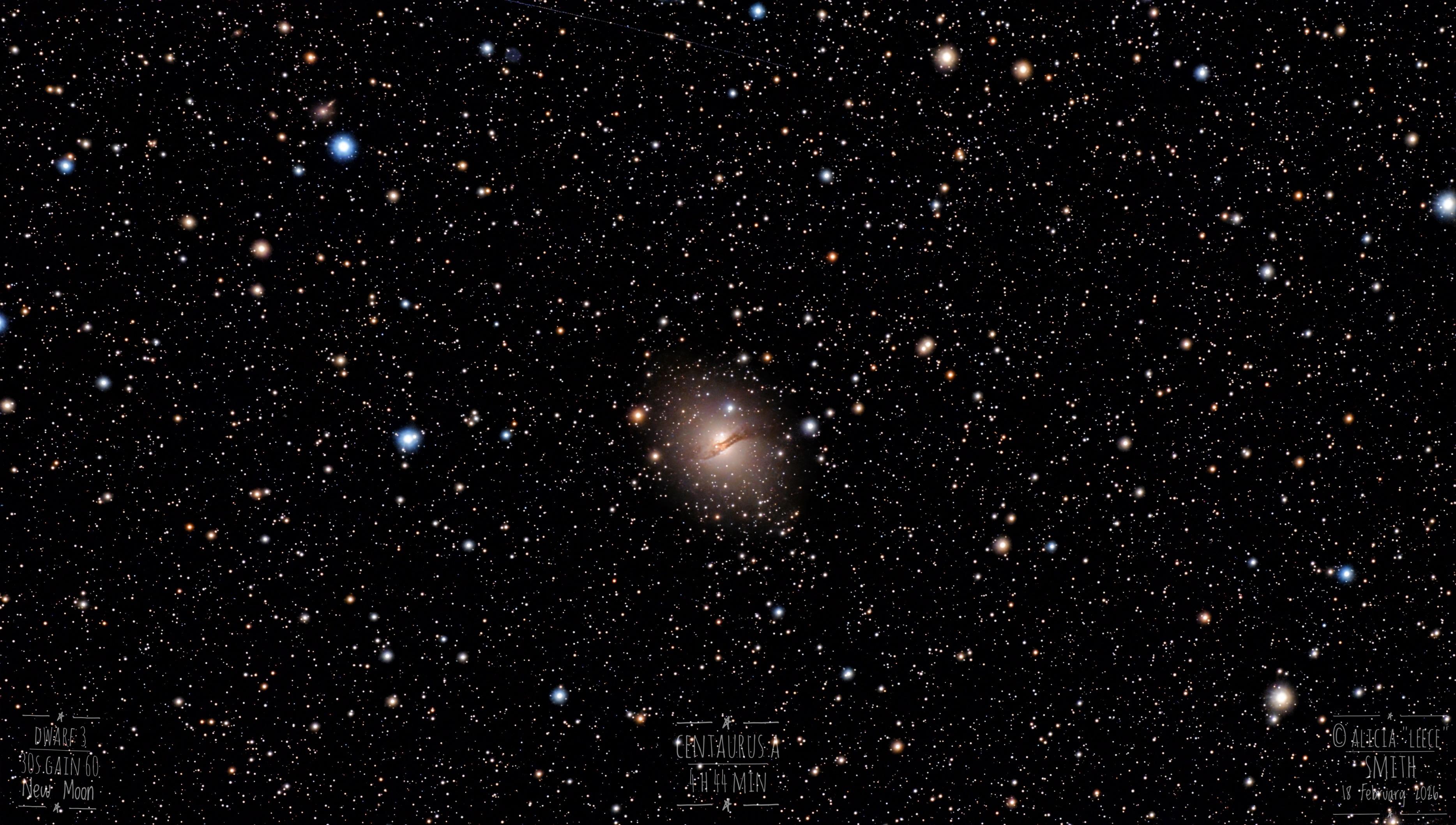
It's been the New Moon, so a good time to get out there with the telescope!
Got some quite good detail with Centaurus A.
I rode this image into dangerous territory last night, because I ran out of space in the telescope, oops, but still it turned out pretty well. Remind me to clear off the scope this arvo!
The first time I processed the image it was pretty bright, it didn't look very natural, so I did this version. I might post the lurid one later.
So who's ready to see the Carina Nebula I did a couple of nights ago after this? Only an hour or so but you'll get to see us Southern Hemisphere types' consolation prize for not having a pole star.
I seem to be Canadian now, which is very exciting. (My paternal grandfather was born in Ontario.) I need to pull together a relatively short stack of documents to prove it (3 birth certificates, 2 marriage certificates, 2 name change records), and fingers crossed Canada (home and native laaaaaand) will welcome me home.
It is supposed to snow AGAIN this weekend. I keep reminding myself that this is how winter is supposed to be.
My to-do list has three MUST DOs on it:
write up notes for therapist before Monday session
read & comment on manuscript for crit group Tuesday
pollinator garden email
If you see me doing anything else except, like, keeping body and soul together for the next few days (if it snows more than half an inch, I'll have to take care of my neighbors, and a friend is coming over with her kid to encourage me to clean and have dinner, but other than that — !), yell at me until I go back to my aforementioned tasks.
I spent this week in slide deck hell and the week before in spreadsheet hell. There is still more slide deck hell to come, but I think I can pace it out a little more now. But spreadsheet hell will not end until May, thanks to HHS (pdf link). I like accessibility work, but I also like digital paleography and information architecture and wireframing and right now accessibility is expanding to fill all the available time and then some. Fortunately, one of the slide decks from hell actually requires me to work on a writing project, so I can cling to some vestige of being a creative person who doesn't live in slide deck or speadsheet hell. Maybe someday I will actually be one! Maybe someday I can contribute to CanLit!
You know the theory for how to get a piece of cake or some such cut evenly between two people? Ask one of them to cut it and the other one to pick. That will give the cutter an incentive to cut evenly and not cheat.
But what if - I was thinking while slicing brussel sprouts in two for B.'s dinner - what if the person doing the cutting isn't very good at slicing exactly in half? Then the cutter will be cheating him/herself.
Terminal hubris yet again took me out to the nearer supermarket, yes on a garbage day, yes after that 10 cm dump. Possibly the Whatever that flattened the sidewalk by me yesterday also did down the block and the snow/ ice piles were from people cleaning off their cars. But possibly the Whatever couldn't touch the ice because people put salt down before the sleet stopped falling which naturally led to an unmoving ice sheet. A common mistake in these parts. But I needed milk onaccounta indulging in daily hot cocoa, and tomorrow will be 5C ie melt, plus rain, which means even more slop, so out I went. Really must get an all-terrain walker, though no guarantee that would handle slush any better.
This is also the reason why, after going to bed last night, I got up and cancelled tomorrow's physio. If the sidewalks are passable I'll see if the spot is still open but I strongly suspect they won't be.
However having prudently put one of the Thermacare disposable heating packs on my grumpy back, I was able to clear the rest of my frontage of the ice layer. Wasn't enough to do NND's but at least it's a start. Only because I did this after coming back from the super I was getting light-headed from all the exertion and needed to rest and do deep breathing from time to time.
A come by chance setting on my tablet which I can no longer find allows you to switch up the wallpaper of one's login. I selected landscapes so now, in the brief interlude before inputting my PIN, I have vistas of forests and meadows and deserts and rivers and mountains. My sadness is that they don't tell you where these places are, and that I only get three seconds to view them before the screen goes black again. But they're a nice little pleasure to offset the annoying FUBARs of this new update.
On occasion, you know the ending of your story before you start writing. Most other times, you find the path as you go, each twisting turn appearing before you as you continue on your merry way. The latter seems to be the case for author Gideon Marcus, who says in his Big Idea that he wasn’t always sure how to wrap up his newest novel, Majera.
GIDEON MARCUS:
What’s the big idea with Majera? That’s a hard one, because there are lots of threads: the unstated, obvious, valued diversity of the future, which helps define the setting as the future. That’s a familiar technique—Tom Purdom pioneered it, and Star Trek popularized it. There’s a focus on relationships: found family, love in myriad combinations. There’s the foundation of science, a real universe underpinning everything.
But I guess what I associate with Majera most strongly is conclusion.
Starting an exciting adventure is easy. Finishing stories is hard. George R. R. Martin, Pat Rothfuss. Hideaki Anno all have famously struggled with it. When Kitra and her friends first got catapulted ten light years from home in Kitra, I started them on a journey whose ending I only had the vaguest outline of. I had adventure seeds: the failing colony sleeper ship in Sirena, the insurrection in Hyvilma, and the dead planet in Majera, but the personal journeys of the characters I left up to them.
I know a lot of people don’t write the way I do. I think writers mirror the opposing schools of acting: on one end, the Method of sliding deep into character; on the other, George C. Scott’s completely external creation of an alternate personality. In the Scott school of writing, characters are puppets acting out an intricate dance created by the author. In the Method school of writing, of which I am a member, the characters have independent lives. I know that seems contradictory—how can fictional agglomerations of words achieve sentience?
And yet, they do! I didn’t plan Kitra and Marta’s rekindling of their relationship. Pinky’s jokes come out of the ether. Heck, I didn’t even come up with the solution that saved the ship in Kitra—Fareedh and Pinky did (people often congratulate me on how well I set up that solution from the beginning; news to me! I just write what the characters tell me to…)
All this is to say, I didn’t know how this arc of The Kitra Saga was going to end. But I knew it had to end well, it had to end satisfyingly, for the reader and for the characters. There had to be a reason the Majera crew would stop and take a breather from their string of increasingly exotic adventures. The worldbuilding! All of the little tidbits I’d developed had to be kept consistent: historical, scientific, character-related. There had to be a plausible resolution to the love pentangle that the Majera crew found themselves in, one that was respectful to all the characters and, more importantly, the reader’s sensitivies and credulity.
That’s why this book took longer to put to bed than all the others. It’s not the longest, but it was the hardest. Frankly, I don’t think I could even have written this book five years ago. I needed the life experience to fundamentally grok everyone’s internal workings, from Pinky’s wrestling with being an alien in a human world, to Peter’s coming to grips with his fears, to Kitra’s understanding of her role vis. a vis. her friends, her crew, her partners. In other words, I had to be 51 to authentically write a gaggle of 20-year-olds!
Beyond that, I had to, even in the conclusion, lay seeds for the rest of the saga, for there is a central mystery to the galaxy that has only been hinted at (not to mention a lot more tropes to subvert…)
Conclusions are hard. I think I’ve succeeded. I hope I’ve succeeded. I guess it’s for you to judge!
Just look at this cover for Monsters of Ohio. Look at it! It is amazing. I am so happy with it. It’s the work of artist Michael Koelsch (whose art has graced my work before, notably the Subterranean Press editions of the Dispatcher sequels Murder by Other Means and Travel by Bullet) , and he’s knocked it out of the park. I am, in a word, delighted.
And what is Monsters of Ohio about? Here’s the current jacket copy for it:
In many ways Richland, Ohio is the same tiny, sleepy rural village it has been for the last 150 years: The same families, the same farms, the same heartland beliefs and traditions that have sustained it for generations. But right now times are especially hard, as social and economic forces inside and outside the community roil the surface of the once-placid town.
Richland, in other words, is primed to explode… just not the way that anyone anywhere could ever have expected. And when things do explode, well, that’s when things start getting really weird.
Mike Boyd left Richland decades back, to find his own way in the world. But when he is called back to his hometown to tie up some loose ends, he finds more going on than he bargained for, and is caught up in a sequence of events that will bring this tiny farm village to the attention of the entire world… and, perhaps, spell its doom.
Ooooooooooh! Doooooom! Perhaaaaaaaps!
If that was too much text for you, here is the two-word version: Cozy Cronenberg.
Yeah, it’s gonna be fun.
When can you get it? November 3rd in North America and November 5 in the UK and most of the rest of the world. But of course you can pre-order this very minute at your favorite bookseller, whether that be your local indie, your nearby bookstore chain, or online retailer of your choice. Why wait! Put your money down! The book’s already written, after all. It’s guaranteed to ship!
Oh, and, for extra fun, here’s the author photo for the novel:
Yup, that pretty much sets the tone.
I hope you like Monsters of Ohio when you get a chance to read it. In November!
The AirPod charging case is the usual elegant Apple design, gleaming and smooth with a nice heft and rounded edges everywhere. It looks great and feels good in your hand. But a flat bottom would have been more practical, so it could sit upright for ease of use. So I rummaged around in my Box of Tiny Boxes and found one that fit perfectly. Cut some cardboard off the flap of a middle-sized box to add a supportive infrastructure, and... voila! Now I can easily plunk the AirPods in and out without having to pick up the case and open the top.
PCs are field agents in charge of finding and dealing with arcane occupational safety violations. That six-sided summoning pentagram? Flagged. That storeroom where the universal solvent is next to the lemonade? Flagged.
That deadly-trap-filled dungeon abandoned by its creator when the maintenance fees got too high? Red tagged.
This isn't the same as my recent FabUlt campaign. That was about discouraging the worst excesses in a world run by oligarch mages and there weren't really regulations. This would be set in a regulatory state, and would be more an exploration of normalization of deviance.
The Buffalo Hunter Hunter by Stephen Graham Jones is gory historical horror set in 1912 Montana that's in conversation with Interview with the Vampire by Anne Rice. More importantly, it's both narrative and meta-narrative about settler colonialism and the genocide Americans perpetrated against the indigenous inhabitants of the American West, viewed through a lens of revenge, survival, and atonement. Finally, it shows a long, difficult attempt at justice, requiring sacrifice and suffering along the way.
A grey day, and the wind is in the north again, very cold. But at least the rain is holding off. And the days are lengthening noticeably. A few days ago, when the cloud cleared briefly, I set off on my morning walk around the forest in the dark. By the time I turned for home, the stars were fading and the sky lightening in the east, and the Woodlarks were starting to sing.
Despite the almost complete lack of sunshine, the first daffodils are starting to flower in one corner of the garden. (No spring crocuses this year. They came up a few weeks ago, but the rain flattened them before the flowers ever got to open...)
I finished the third book in the trilogy just before going to sleep last night. It was a good read, but when all is said and done, I feel like there are a number of loose ends that, when tugged at, cause the whole thing to threaten to fall apart, if not to actually do so.
My main objection is the rest of the world. The events in the trilogy happen in the US, and we're told in mentions here and there that the rest of the world is different, likely doing better. But, except for a couple of very specific events — which are instigated by Americans — the rest of the world just stays out. The closest analogy I can think of is North Korea. Except that North Korea invests a lot in its military to keep the rest of the world out, whereas Kress's America seems to have no functioning military, or at least none that ever gets mentioned. It's like the rest of the world just goes "Oh, they're crazy. Let's stay out of there." Which doesn't seem likely, because people have time and time again demonstrated a complete inability to leave people alone.
And while the ending of the final volume is somewhat more satisfying than the ends of volumes 1 and 2, it also very much sets it up for Kress to potentially write a fourth book. And not a small opening. Imagine if Lord of the Rings had ended with a bookseller unpacking a crate of old books they'd just bought, finding a copy of How to Make Rings of Power: Complete and Unabridged by Sauron and trying to decide whether or not to put it on the shelf.
So more or less a mixed reaction. Some parts I though were good, some parts not so good. Thought-provoking, though not necessarily in the ways the author intended.
Also, I've got one comment on the physical book (and so nothing Kress could have done anything about): Maybe publicity works different in publishing, or maybe the publicity department at Tor in the mid-'90s had never heard of "underpromise then overdeliver," but I found the front cover text on this book kind of hilarious:
![[personal profile]](https://www.dreamwidth.org/img/silk/identity/user.png) sovay
sovay![[community profile]](https://www.dreamwidth.org/img/silk/identity/community.png) threesentenceficathon, most recently the one I threw out originally for an episode of TNG I hadn't seen since childhood. The latest pebble
threesentenceficathon, most recently the one I threw out originally for an episode of TNG I hadn't seen since childhood. The latest pebble 

![[syndicated profile]](https://www.dreamwidth.org/img/silk/identity/feed.png)